The Origin of Kopi Luwak|The True History Behind the World’s Rarest Coffee
Kopi Luwak, often referred to as civet coffee, has its origins in the islands of Java and Sumatra in Indonesia. Its history can be traced back to the Dutch colonial era, specifically during the Cultuurstelsel (Cultivation System) from 1830 to 1870, when coffee became one of the most important cash crops in the Dutch East Indies.
A Forbidden Coffee for the Natives
During this period, the Dutch introduced highly prized Arabica coffee beans from Yemen and established large-scale plantations. These coffee beans were considered luxury commodities, reserved strictly for European aristocrats and high society.
Local farmers and commoners were prohibited from consuming or possessing the coffee beans, even though they were the ones working in the plantations.
Despite the strict rules, curiosity and the aroma of roasted coffee tempted the local farmers to find a way to taste the beverage without breaking the law.
The Discovery of the Luwak (Civet) and Its Coffee Beans
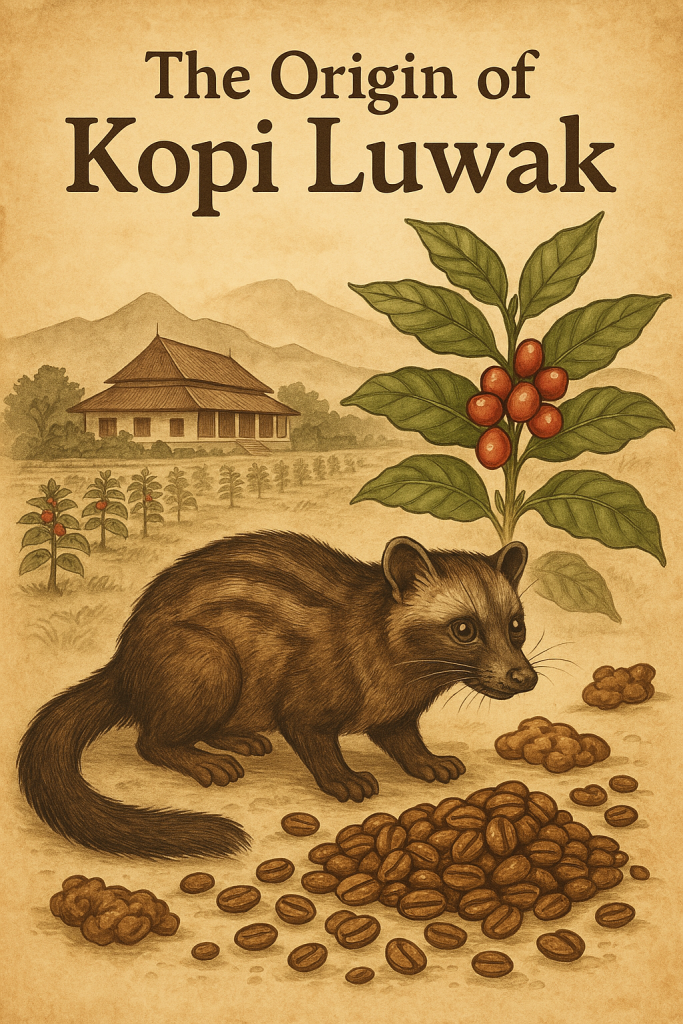
While working in the plantations, farmers noticed the Asian palm civet (Luwak) frequently visiting the coffee fields to eat ripe coffee cherries. Later, they realized that the civet excreted undigested coffee beans in its feces.
Because part of their job was to clean the plantation grounds, farmers collected the civet droppings as usual, but eventually, they secretly cleaned the beans, roasted them, and made their own coffee.
This unusual and natural process soon became known as “Kopi Luwak.”
From Accidental Discovery to Premium Coffee
To the farmers’ surprise, Kopi Luwak produced a coffee that tasted smoother, less bitter, and more aromatic than the regular coffee they encountered. As they refined their preparation methods, they unknowingly became the earliest Kopi Luwak connoisseurs.
Over time, word spread about this unique processing method involving:
Natural selection by the civet (choosing only the ripest cherries)
Fermentation inside the civet’s digestive system
Distinct flavor development during the process
Even today, Kopi Luwak remains one of the most premium, rare, and culturally significant coffees in the world.